
AI & Machine Learning
Plan Ahead with Data-Driven Forecasts
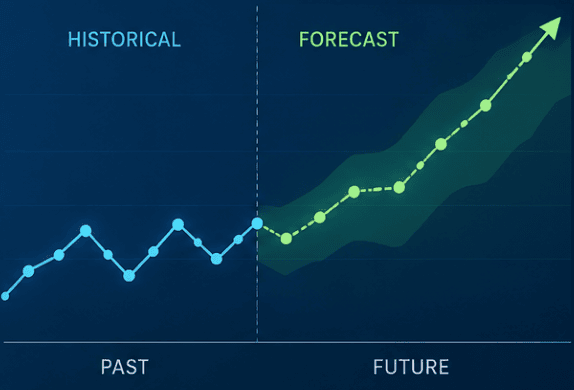
Making decisions about the future is challenging when businesses rely solely on intuition or historical trends. Forecasting using machine learning helps organizations estimate future outcomes by identifying patterns in past data and using those patterns to generate more informed predictions. This can support planning, budgeting, resource allocation, and strategic decision-making.
This service can be applied to a wide range of business questions, such as forecasting sales, customer demand, inventory requirements, revenue, website traffic, or operational workloads. By providing a clearer view of what may happen in the coming weeks, months, or years, businesses can reduce uncertainty and prepare more effectively for opportunities and potential challenges.
The goal is not to predict the future with perfect accuracy, but to provide reliable, data-driven insights that improve decision-making. Organizations can use these forecasts to optimize operations, reduce costs, improve customer service, and make more confident business decisions based on evidence rather than assumptions.
Predicting Customer Churn for a Beverage Company
One example of the kind of predictive model we build — the same approach applies to demand forecasting, booking cancellations, no-show prediction, and other business questions.
Customer churn is hard to notice until the revenue impact is already significant — without a clear signal, it's difficult to know which accounts need attention before they're already gone.
By analyzing order history — declining frequency, smaller orders, longer gaps between purchases — it's possible to estimate the likelihood a given customer will churn before they actually stop ordering.
- Earlier, more targeted retention efforts
- Prioritized outreach on highest-risk accounts
- Reduced revenue loss from unnoticed churn

Need a different kind of prediction?
Churn risk is just one example. The same approach applies to booking cancellations, upselling opportunities, and other business requirements.
Common questions
What data do I need to run the notebook?
A working Python environment — such as Jupyter, Google Colab, or Anaconda — and your own customer or order history in the format described in the notebook's documentation. Basic familiarity with running Python code is helpful, since you'll need to load your own data into it and run each step — this isn't a fully automated, no-code tool. If you'd like to build up this foundation first, our published books on data science are a good starting point.
How is this different from a BI dashboard?
A BI dashboard visualizes your own data. This notebook doesn't visualize anything — it uses machine learning trained specifically on your data to produce accurate, individual-level predictions for each customer, not just a picture of your numbers.
Can you build a model for a different business question?
Yes — churn prediction is just one example. Get in touch to discuss what you're trying to predict and we'll scope a custom model around it.
Interested in machine learning and forecasting for your business?
Get in touch to explore how data-driven predictions can help you plan ahead.