Description
Market Basket Analysis — Jupyter Notebook (Python)
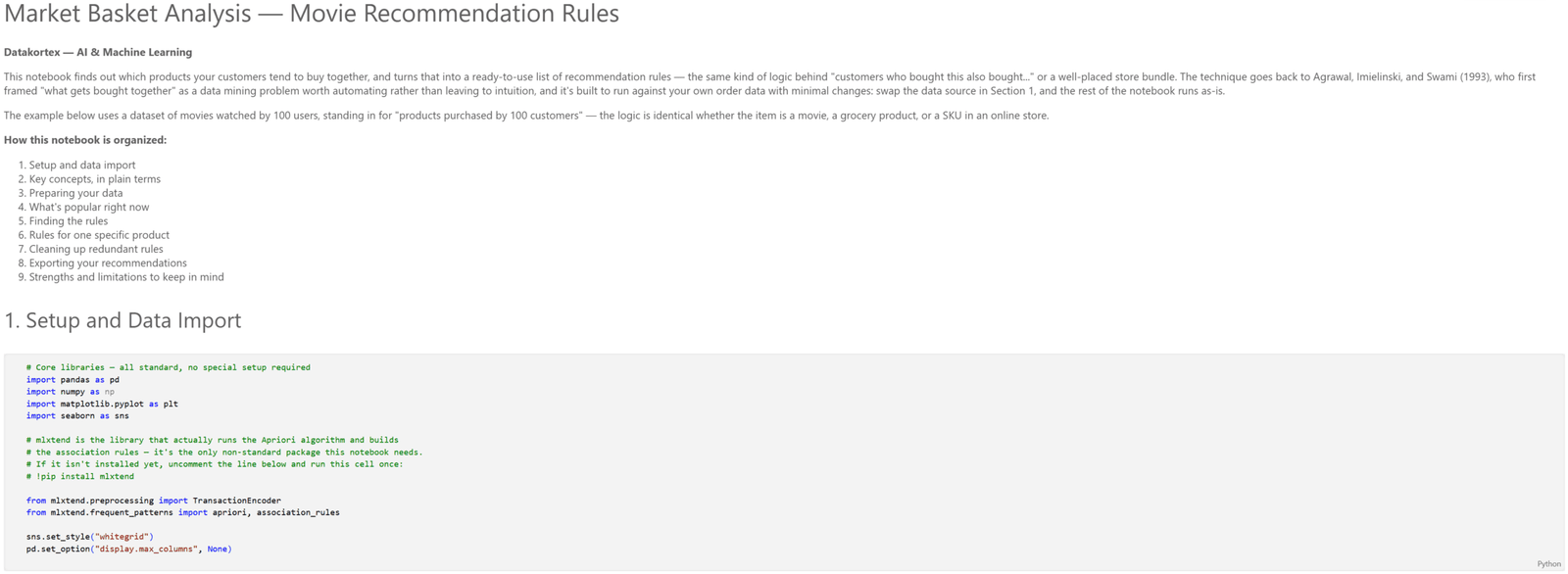
Knowing which products your customers buy together is one of the simplest, highest-leverage insights a business can act on — and one most businesses never systematically uncover. This notebook builds a working product recommendation engine from your own order data — using the Apriori algorithm — and walks through every step, from preparing your transaction data, through to a ready-to-export list of recommendation rules.
What’s included:
- A fully commented Jupyter Notebook (.ipynb), broken into clear, explained steps
- Automatic transformation of your raw order data into the transaction format the algorithm needs
- Association rule mining using the Apriori algorithm, with plain-language explanations of support, confidence, and lift
- A built-in method for zooming in on rules driving customers toward one specific product
- Automatic detection and removal of redundant rules, so you’re left with a clean, non-repetitive set of recommendations
- A final, ready-to-run script that exports your recommendation rules to CSV
How it works:
The notebook is built around your own order-level transaction data — one row per item purchased. It walks through converting that data into a transaction matrix, mining association rules at thresholds you control, filtering out redundant rules, and exporting the final set as a clean recommendation list. Each step includes a plain-language explanation of what’s happening and why.
Please note: this notebook is provided as working code you run yourself, not a hosted service — you’ll need a Python environment (such as Jupyter, Google Colab, or Anaconda) to run it. Basic familiarity with running Python code is helpful, since you’ll need to load your own data in and run each step. Every business’s data looks a little different, so you should expect to adjust a couple of column names to match what’s actually available in your own dataset.
Recommended fields — your order data should ideally include:
- Customer ID or Order ID
- Product or item name
These two columns are all the notebook strictly needs to run. Enough orders are needed to produce meaningful patterns — the more transactions in your history, the more reliable and specific the resulting rules will be.
Format: Delivered as a .ipynb Jupyter Notebook file.
Requires a Python environment (Jupyter, Google Colab, or Anaconda) to open and run.